

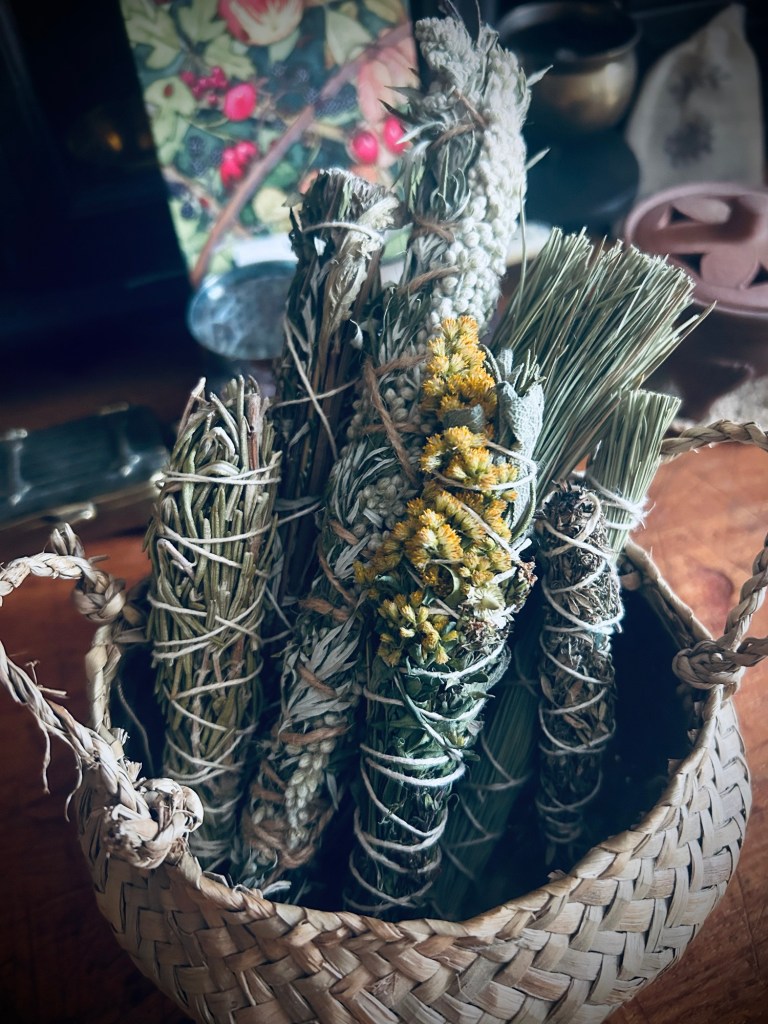
White Sage (Salvia Apiana, also known as Californian white sage and Sagebrush) is a herb native to North and South America, used by indigenous people for ‘smudging’ – a traditional, ceremonial smoke cleansing. All indigenous cultures burnt herbs for various reasons, ceremonially and medicinally and some known western practices such as ‘saining’ in Scotland and ‘censing’ – ceremonial incense burning in the UK and Europe, still remain today.
We know that the Greeks, Egyptians and Romans burnt herbs for purifying the air and making offerings, so there is a rich history of smoke cleansing all around the globe.
While many indigenous North and South American teachers have shared their practice of white sage smudging with the modern world, the growth of smudging and its popularisation within the wellness community and dare I say, industry, have increased demand for white sage.
This has sadly led to its commodification and commercial, unsustainable harvesting practises. Whole plants are being unceremoniously uprooted to meet demand abroad, so it’s becoming scarcer for indigenous communities. This also means there’s a large carbon footprint involved in flying bundles of American herbs halfway round the world just so holistic practitioners like myself can waft them about! So buying white sage, although it burns well and smells nice, is sadly not an ethical or environmentally friendly choice for a cleansing herb if you’re based in the UK.
I’m always surprised by how many holistic practitioners still only use bought white sage (or incense brands made from chemicals to produce the scent,) despite there being so many wonderful native herbs (or naturalised herbs from thousands of years of growth and use,) that can serve the same purpose while being better for the environment, and smell as good, if not better!
Another reason for choosing local, native herbs, apart from the ethical and environmental reasons, is to make a connection to the land around you. If you can grow or forage the herbs yourself that’s even better. Herbs can even be grown on windowsills and very easily cultivated from cuttings, making them affordable and accessible to most people.
Growing and/or foraging local herbs gives you the opportunity to build relationships with the land and the plants, which makes herbal incenses even more special for ritual uses, as the herbs/incense are infused with connection, intention and harmonious energy exchange, right from the beginning,
With local herbs you can create ways to harvest them in ceremony. Approach the plant and get to know it, make friends with it as you would a person. Meditate with it and ask questions, ceremoniously drink/eat the herb and ask if it is willing to work with you and share its wisdom. Always ask first if you may cut it and always leave an offering of some kind (some dried herbs, water, even a song!) in return.
Always pay attention if you hear a ‘no’ from a herb. On a very frosty day I wanted to collect rosemary from a large plant I had growing and heard/felt a distinct ‘no’. I was surprised as I’d never had a ‘no’ before, but adhered to the instruction. After reflection with the plant and later googling to confirm, I realised it was because taking cuttings of plants like Rosemary encourages growth (another very good reason for using herbs like this sustainably!) but on a very frosty day it would have exposed the plant to the cold and triggered it into action, and it clearly didn’t appreciate that! Ever since then I will always ask and listen to/abide by the response.
Here’s just a small selection of native herbs to look out for as an alternative to buying white sage, or to grow yourself and build bonds and relationships with:
Mugwort: Mugwort is really our UK native equivalent to White Sage, as it was held in such high regard by our indigenous wisdom keepers. It’s a wayside herb growing disguised as a common ‘weed’ usually on poor-quality wasteland, at the side of roads or at the edge of farmland and meadows. It’s getting harder to find in the wild as more land is built on. It’s considered one of our most magical herbs adored by every witchy woman I know! Its Latin name is Artemisia Vulgaris, named after the Greek Goddess Artemis, whose Roman equivalent is Diana, so the plant is associated with Goddesses and Goddess worship. Mugwort’s alternative name is ‘cronewort’ as it was used by elder, wise women – the village herbalists and midwives, and has many medicinal applications relating to women’s health. Mugwort hits her peak at the Summer Solstice when she is traditionally harvested. She smells amazing fresh, having deep earthy tones that when inhaled go straight to your head! Mugwort when dried does burn very well, although it isn’t a fragrant herb like the Mediterranean herbs, it is incredibly pungent and earthy when fresh, but smells quite generally smoky and ‘grassy’ when burnt, though it is incredibly potent. Mugwort relates to insight, divination and prophetic dreaming. Also to protection, cleansing, strength and healing. If you’re lucky enough to have mugwort growing locally or can grow it yourself as I do, it will usually grow plentifully and voraciously enough to harvest for use throughout the year as incense until the next harvest.
Pine: There are many varieties of Pine trees with the Scots Pine being the only originally native variety the UK. They grow in many parks here and along roadsides. Several varieties have long (and very sharp!) aptly named needles, which can be gathered from fallen branches and clusters, dried and burned. It burns well for a few minutes at a time but has a very cleansing, pure, sweet smell. Its traditional uses include cleansing, protection, healing, fertility and abundance. Cedar of Lebanon is a type of pine with very short needles and papery cones. The dried cones, needles and ground wood smells amazing and has many magical/spiritual connotations that also include protection, cleansing, healing, longevity and grounding.
Rosemary: An incredibly versatile herb from the Mediterranean originally, now common in most British herb gardens and borders. Primarily known as a culinary herb but it has so many medicinal applications. As with most medicinal herbs it is also connected to traditional uses such as cleansing/purifying, exorcism and protection. It’s also connected to aiding sleep, love, vitality and aiding mental power. It burns well with a nice pure smoke and smells lovely.
Sage: UK garden sage (Salvia Officinalis) doesn’t burn as well as white sage because it doesn’t dry as brittle, but when added to bundles with mugwort and rosemary it burns well with the others and gives off a very lovely sagey smell. Its traditional associations are immortality, longevity, wisdom, protection (again due to its many medical uses) and for making wishes come true. There’s also some strange folklore around sage including that it’s bad luck to plant sage yourself in your own garden!
Thyme: There are native varieties of Thyme in the UK, although we mostly tend to only see the cultivated varieties growing in herb gardens. Its traditional uses are purifying – ancient Greeks burned it in their temples and for medicinal reasons, to purify the air of germs when people are sick. Thyme’s purifying abilities have now been proven by scientists, so there is much more to cleansing than just ‘new age’ wishful thinking! It was burned to fumigate rooms from illness so it’s very handy to have to hand if someone visits you with a cold! It is said to help with healing and sleep and it was also said to aid psychic powers, attract love and courage. It burns well and smells sweet and fragrant.
Vervain: Vervain (Verbena Officinalis) was prized by the ancient Druids and has folk names including ‘Herb of Enchantment’ and ‘Holy Herb’. It’s quite hard to find in the wild but I’ve been growing it successfully for the last few years. It isn’t aromatic but it does burn well. It has very delicate pink flowers that grow in sets of three up the stalk, almost like a trident. I’ve often wondered if that’s part of the reason why the Druids held them as sacred, as they had many threefold symbols, although there is no direct written evidence of Druid lore, it’s only from Roman writing. The Romans themselves burned vervain in temples dedicated to Jupiter, and it is said that they used them like besoms to sweep surfaces like altars in their sacred spaces. It’s another medicinal herb, especially useful as a nerve tonic. Its traditional magical uses include: protection, purification, love, peace, abundance, aiding sleep and healing.
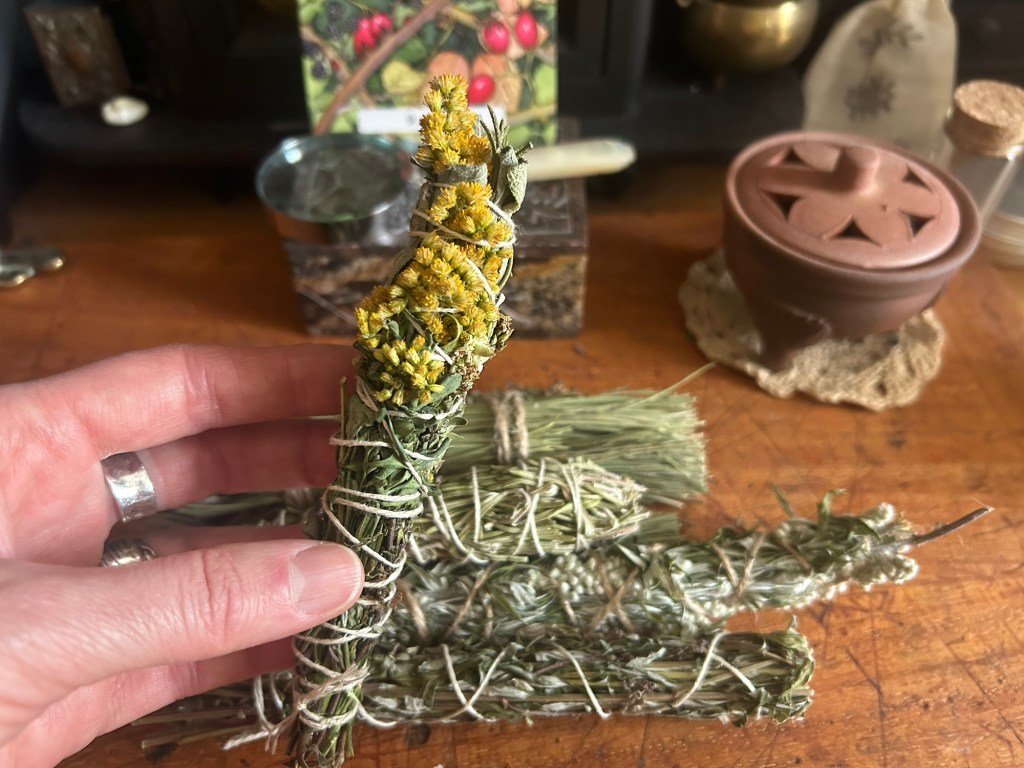
I hope this has inspired you to try growing or foraging for your own local herbal incense!
Note: Always be very cautious with mugwort (even inhaling smoke) if you pregnant or trying to conceive. Always do your research about the effects of herbs on humans and animals. Always be sure about identification of plants before burning or ingesting. Most herbs are very potent and some are toxic. Always burn in well ventilated spaces.
 Nature-focused, Shamanic Reiki Drum, Reiki & Reiki Massage, Forest Therapy