

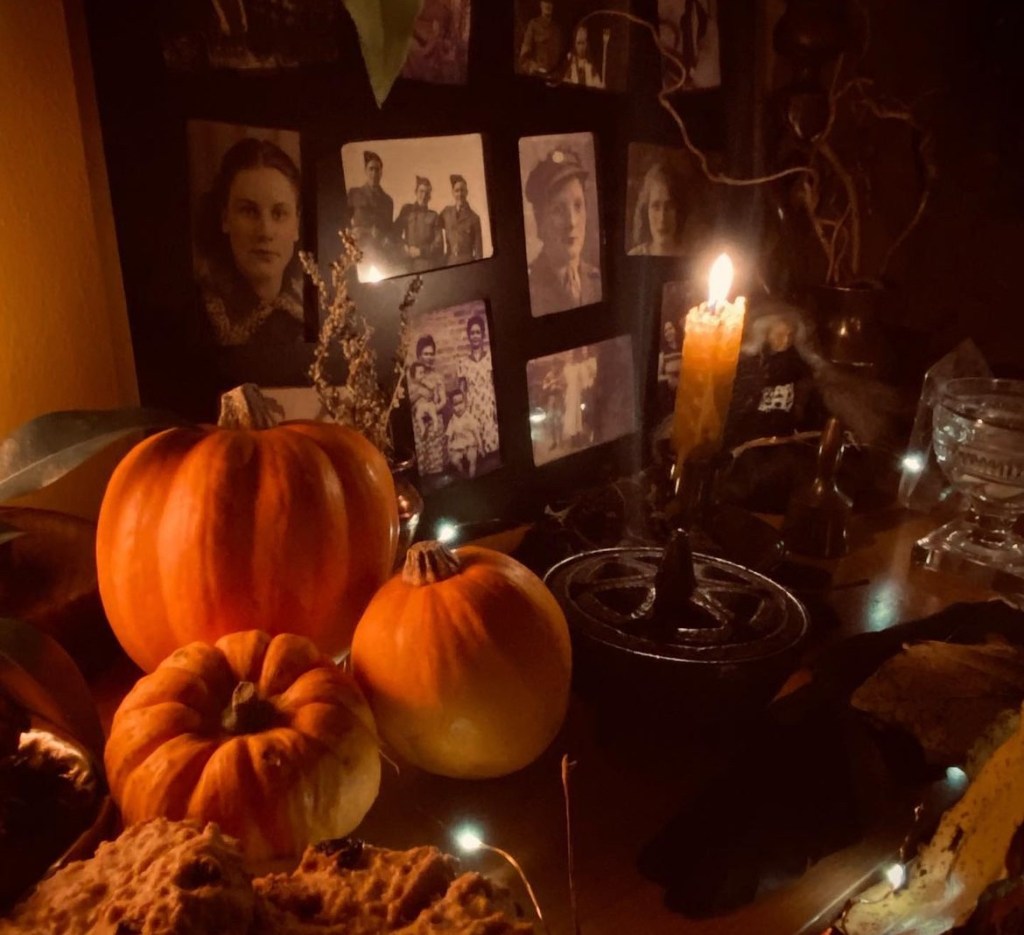
Today marks calendar Samhain (pronounced Sa-win), a festival with ancient Celtic origins traditionally celebrated in Ireland, Scotland and on the Isle of Man, on the evening of 31st October into 1st November. The festivities traveled to America in the 1800s and morphed into the modern day Halloween.
Samhain was universally adopted by all neopagan traditions and has grown in wider popularity more recently with the increased interest in reconnecting to Nature’s wisdom.
The word Samhain derives from a couple of ancient words that can point to either ‘summer’s end’ and to ‘uniting’ or ‘together’, linking it to ancestral veneration and the idea of the ‘thinning veil’ between the worlds of the living and dead. Samhain is sometimes referred to by pagans as the ‘Celtic new year’ but that has been debunked by historians, so is now celebrated by pagans as the doorway to winter and/or ‘the witches’ new year’.
It was and still is, the time of the last apple picking, for celebrating the end of all the hard work of the harvest and entering with intention, through a metaphorical gateway, into the winter months.
This celebration and time of year is known for its ancestor veneration in many different cultures all over the world, so Samhain is synonymous with death.
Samhain was also the time of year when the grazing animals would be brought in for the winter, with many being slaughtered for the winter stores, hence it being a time for feasting and another example of the link to death. Ancient sites have revealed clues to ancient practices of ceremonial honouring and offering connected to venerating the deceased animals too.
Because death is still very much a taboo in the western world, we can miss some of the significance of Samhain and therefore miss the opportunity to explore our own fears, feelings, emotions and concepts around death.
When we talk of the ‘veil thinning’ and ancestral veneration, we think of those who have gone before us, but we can sometimes miss this opportunity for contemplating our own mortality and the cycle of life we are part of. We can learn deeper mysteries from examining nature’s displays, and by allowing ourselves to wonder what lies beyond the veil.
All around us in the northern hemisphere, nature is slowing down, releasing, decaying and composting, showing us how to let go with confidence. Trees, plants and animals, pause and rest before the renewal and growing phase in spring. In the Southern Hemisphere, nature is now blooming again after the winter rest and is being celebrated with the fertility festival of Beltane.
The continuity of the seasonal cycles and constant rotation of the seasons of birth and death is highly significant: it shows us they are cycles, not opposites. So death can’t be the opposite and absence of life because it is within the richness of decay that new life is created. When we really examine this, there is never a complete absence of anything, it is always a transformation and continuation, beyond what we can merely perceive. A simple example of this is the dark of night. The itself sun hasn’t moved, we’ve only rotated in our cycles, changed position and perspective.
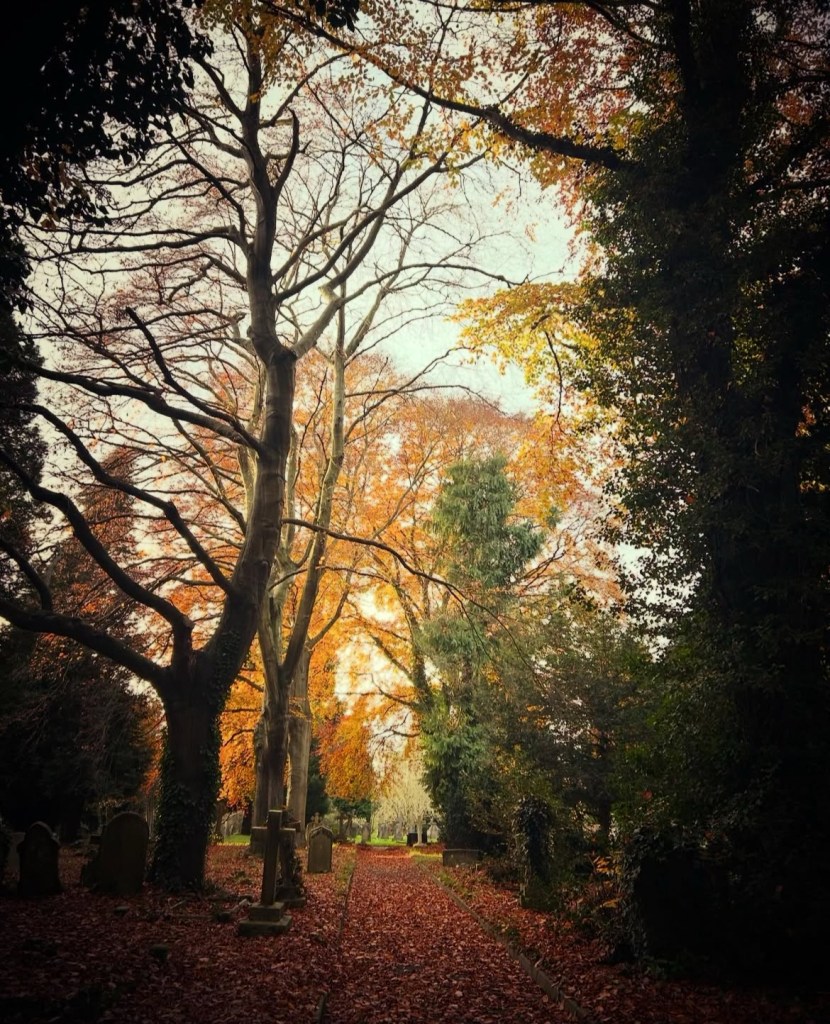
If we take time to notice the mystery of all this it can literally be life (and death) changing. Perhaps take time for a walk today, to notice how the leaves are now dropping, browning and blackening. I find it interesting that ‘blackening’ is also the name of the first stage of transformation in old alchemy that began any alchemical work. The term was later used by Jung as a metaphor for transformation, but we see this for ourselves all around us in the natural world at this time of year.
It’s the mulching down into the dark, moist, fertile compost that’s alive with microscopic life. It’s from the darkness of this fertile earth, which holds all the necessary components for creation, that new life, new seeds and roots grow. This is mirrored in the womb, in the void of space and in winter. As above, so below, as within, so without.
If we take time to join these dots we can notice something very important: what we call ‘death’ was never the opposite of life. It was never ‘only’ an ending but a transformation that is ‘alive’ with new beginnings.
If we follow the lifecycle of a leaf from bud to compost, we can see that the essence and energy beneath the matter that created the bud, transformed into a leaf, faded, dropped and decomposed, is still present. The leaf has only changed form. If we could microscopically mark an atom in the leaf, we could follow that atom’s journey of transformation and see that in essence it has never ceased to exist.
At Samhain season, Nature is teaching us Her wisdom, the knowledge that our ancient ancestors held. They knew how to embrace, honour and celebrate the alchemy of endings, the mystery and necessity of releasing, transforming and transmuting, that which brings forth the new. We are slowly remembering all of this.
So we can embrace this season of darkness as sacred, not just on one day, but for the whole period between now and the renewal at Imbolc in February. This is an important gap or bardo (as they call it in Tibetan Buddhism), where we can explore the nature of death as transformation.
It is called a liminal time – a palpable threshold and boundary – but perhaps the veil is thin because nature’s secrets become visible? Mother Nature is showing us that when we look closely the nature of death, it is revealed as rebirth – the paradox of both/and that requires the lightness of liminality to hold. We need to rest on a boundary that’s between the opposites of ‘this and that’ to fully appreciate the significance of it. This is the ‘middle way’ as taught by the Buddha and is synonymous with the path of Enlightenment, or the realm of the hedge witch in western shamanism, one who lives in wisdom on the boundary, one who inhabits liminal space.
Perhaps we can use Samhain season to explore nature’s teachings with awe and curiosity, to grow in confidence to break the taboo (a word originally meaning ‘sacred’,) and contemplate the subject of death more openly and courageously. To shake off the fear that death is only loss, but embrace it as a both/and – a loss and a renewal at the same time. I believe this paradox is one of the great mysteries at the heart of nature’s constant spiralling cycles that we are all part of.
Incidentally I much prefer the term Hallowtide (as used by the wonderful author and teacher Val Thomas in her book of the same name,) instead of Samhain. It has no cultural connotations, mispronunciations or appropriations, but emphasises the sacredness and depth of the season.
Hallowtide blessings!
 Nature-focused, Shamanic Reiki Drum, Reiki & Reiki Massage, Forest Therapy