

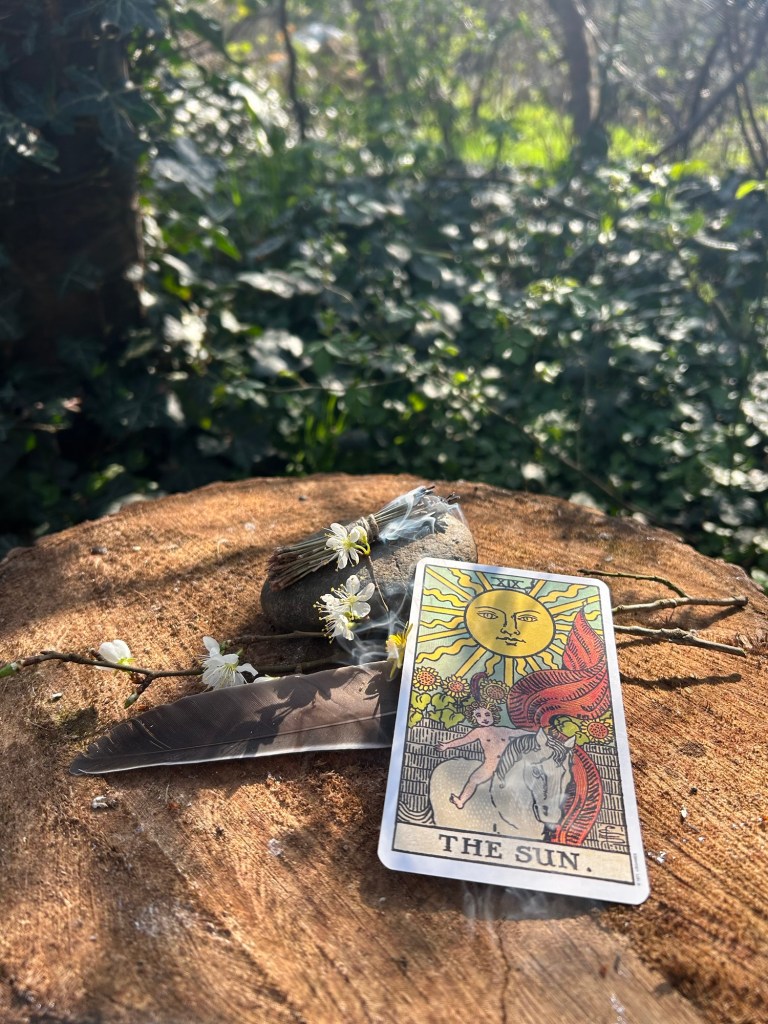
The weeks are flying by and the days are now noticeably longer. The blossom is appearing and spring is certainly in the air and on the birdsong.
The next seasonal celebration for those tuning into nature’s cycles is the Spring or Vernal Equinox falling on 20th March, when the sun’s rays fall directly on the equator creating an equal length day and night, a perfect balance.
Celebrating nature’s cycles such as the solstices and equinoxes have seen a huge spike in mainstream interest recently. It has been heartening to see this growth in nature-centred living and spirituality.
As more people feel drawn to celebrating the neopagan ‘Wheel of the Year’, it is perhaps inevitable that these festivals are also adopted by more mainstream organisations, brands, and advertisers responding to what they see as a growing cultural interest.
Alongside this, I’ve noticed an increasing use of neo-pagan names and terminology, sometimes presented as ancient practice. This is completely understandable. In uncertain times, many of us are looking for comfort and support. We’re searching for meaning, continuity, and connection from a broken lineage. We’ve all been severed from our roots and are finding familiarity in nature-centred practices that feel older than they are. I think this is because they are resonating with something deep and instinctive within us.
So I felt it was important for my own practice to do some research so that my nature spirituality is grounded in both facts and my personal experience and resonance, rather than any assumptions or misinformation.
With this in mind, I thought I would share my own research into the upcoming festival celebrations known as Eostre and more recently and commonly called ‘Ostara‘, which is really only the Wiccan name for the festival that’s celebrated at the Spring Equinox. As Wicca is an initiatory, modern religion, it doesn’t feel quite right to co-opt Ostara as a blanket term, and is why I am distinguishing between Eostre and Ostara.
Firstly, let’s look at the word and name Eostre. It does appear in British historical records, but only once, in the writings of the renowned eighth century monk known as the Venerable Bede. He records that the month known as Eosturmonath (what would now be April,) was named after a goddess called Eostre, whose feasts were held in spring. He also wrote that that the Christian festival of Easter had taken its name from this month. It’s also worth noting that during that time the first month of the year was March, with new year celebrations falling after the Equinox.
There are no other surviving written sources, rituals, objects or temples, relating to Eostre, it is only this brief reference to the Goddess and her season that allows us to link through the millennia to this ancient name and celebration.
While Eostre has clear evidence-based roots, Ostara, by contrast, appears much later. The name is generally attributed to the 19th-century folklorist Jacob Grimm, (of brothers Grimm fame,) who proposed a Germanic counterpart to the Anglo-Saxon Eostre, drawing on linguistic patterns and European folk customs, rather than any direct historical evidence.
It is from this point that the goddess called Ostara began to morph into the cultural consciousness as a fertility goddess, incorporating symbolism from other European folk traditions but with clear links to the ancient Eostre.
More imagery, symbolism and practice began to surround Ostara as primarily a fertility goddess, with images of eggs and hares dominating – two very prominent signs of the Spring season in rural, farming landscapes.
Later on in the mid-20th century, the name Ostara was utilised by Gerald Gardner, the British founder of the Wiccan witchcraft religion, who named Ostara as one of the eight Wiccan ‘sabbats’ or festivals and cemented the name and symbolism into British neopagan culture.
So Ostara is not a name of an ancient Goddess, but a modern interpretation based on ancient sources and what remained of European folk traditions, emerging and popularised as part of a (initiation based) religious group.
Despite there being only one piece of canonical written evidence about Eostre, there are many linguistic clues to follow up on, to deepen our connection to Her and what our ancestors may have celebrated. I suspected that clues to Eostre would be found by looking up to the sky in the present moment, rather than looking back to the past or digging down archaeologically speaking.
The sky is one of our greatest resources for connecting to ancient practice because its rhythms and cycles of the sun, moon and stars, are the same ones our ancestors watched and oriented to, thousands of years ago. We are still living under those same patterns of light and cycles.
Eostre linguistically is, as suspected, connected to the Old English word for east, which is rooted in much older descriptive meanings and qualities of the sunrise and dawn light.
At this time of year the sun’s rising point is due east, arising precisely east at the equinox. After the equinoxes the rising point appears to travel north-east, creating our longer days until the summer solstice, when it seemingly pauses and travels back towards the east for the autumn equinox and then onto south-east during the winter months.
So the ancient goddess Eostre is very likely to have been celebrated and named in relation to return of the sun to its east position during the month of Eosturmonath, as Bede called it. This places Eostre in great company alongside other very ancient dawn goddess figures found across continents and cultures. This includes the very familiar sounding Greek goddess Eos, the Roman counterpart Aurora and the Vedic goddess Usha, to name a few.
These dawn goddesses all share many similar traits, including that they are bringers of light, are youthful, fleeting and liminal; that they bring hope, change and renewal. Dawn goddess are representations that embody the qualities of the light as it returns with the coming of spring.
When we view Eostre from this perspective, to me she starts to make much more sense and feel more like a representation of the qualities of the changing season that we are invited to notice for ourselves. That Eostre is a quality of light and renewal to experience, rather than simply the name of a festival or a mythological goddess.
When seasonal celebrations become named and fixed in the calendar, we often miss their original purpose. Nature-based practices were never going to be about scripted rituals or any doctrines or marketing, or about buying the ‘correct’ altar decorations. Something much older, simpler, subtler and more important is lost when we forget our living relationship with land and the sky and replace our own experience with prescription, instruction or consumerism, or when we only follow what we are told we ‘should’ be celebrating.
Instead, I think it’s so important to spend time outside, alone or with like-minded people, in communion and celebration, simply noticing Eostre as the quality of the season and the little signs of renewal that are everywhere.
At this time of year it is lambing season, edible plants are regrowing and crops are planted. Our early farming ancestors would have lived in deeper reciprocity with the Earth. Folk traditions survive today for blessing the land, giving thanks and feasting on any abundance, so we can safely assume participation in celebratory feasts of gratitude, offering and blessing that we may like to engage in ourselves.
So this Spring Equinox, this season of Eostre, I will be looking up to the sky and especially to the eastern horizon. I want to step outside and into the light of early spring mornings to sniff the air and smell the blossom, to hear the birdsong and to notice the unique quality of light that heralds Spring and honour that experience as Eostre.
There is something so uplifting about those fresh and chilly spring mornings, often still a little frosty, when the sunlight is still gaining strength. That quality of light is the youthful Eostre bringing messages of hope for the renewal of the land and the return to verdancy, the greening that will peak at Beltane in May. It seems likely to me that it is this quality our ancestors experienced and personified with the name Eostre: she of the dawn and new beginnings that we still associate with the direction of east.
The older I get and the more seasonal celebrations I cycle through, the less I am interested in spiritual hyperbole or in re-enacting someone else’s ideas based in something I can’t verify experientially. I find it more meaningful to let the qualities of the seasons speak to me. We can allow meaning and ritual to arise from our own direct experience and allow ourselves to open to that wholeheartedly. There can be nothing more authentic.
So Eostre I am celebrating simply with little acts of awareness, attention and gratitude, by feeding the hope that the spring brings. I want to acknowledge the return of the light and renewal in everyday gratitude practice. I want to look and listen to what the season itself is saying and perhaps the memory and felt sense of what Eostre meant to our ancestors will stir within me through being present, through resonance.
I’m not pooh-poohing any modern Pagan traditions, (only the cynical trend-jumping of advertising and marketing!). I’m following a little nagging feeling that leads me to listen more intently to what feels right and true for me. I don’t feel comfortable jumping on a trend and treating Ostara as if it’s a blanket term or ancient festival, especially as I’m not Wiccan. And I’m not comfortable fixing these seasons with modern dates, symbols and superimposed meanings.
So this season of Eostre, I want to take time to pause and listen, to look to the east, and to greet the returning light as it finds me. Rather than relying on any fixed symbols and meanings, I want to allow my relationship with the seasons to deepen naturally through my direct experience, though awareness, attention and presence. I find I resonate so much with what Hildegard of Bingen called viriditas, the sacred greening that returns at this time of year, not only in the land, but within us too, when we allow ourselves the time, space and stillness to pause, observe, connect and remember.
Simple Eostre Celebration Ideas
Go for a walk at different times of the day. Notice the quality of the light in the early morning, midday and sunset. Notice where the sun rises and sets each day. Feel into this threshold of Spring.
Listen to the change in birdsong and its louder intensity. How many birds can you identify? Can you learn to recognise their songs? If your heart could understand the language of birds, what might they be saying?
Join the birds and sing sacred songs (make up songs using vowel sounds,) at dusk and dawn. Let your heart sing songs of hope and renewal.
Notice the blackthorn blossoms, they are now white in the hedgerow. It blooms before growing leaves so it stands out against the dark bark and other bare trees and hedges. Look for hazel and birch tree catkins and pink cherry blossom.
The soil smells different and richer at this time of year as the land wakes up, can you notice that new smell similar to what is called petrichor after rainfall?
Notice the first time you see a bumblebee or ladybird. Make notes of these as little joys, little signs of hope.
Ask yourself what is renewing in you? What is in need of renewal? Do you still feel the pull of hibernation or a stirring to change something and grow? Perhaps an ebb and flow of both?
It’s a great time to begin a refreshing spring clean and declutter at home. As the birds are building their nests, tend to your own.
Can you feel that you’re a part of this transformation and renewal of the Earth in the northern hemisphere?
Let that connection move you into balance at the Equinox. Feel yourself connected to all the elements and all living things as we transform into spring.
Give thanks to Eostre as she embodies the seasonal qualities.
Honour her in the morning, perhaps light a candle. Leave bird seed and nesting materials as offerings.
Plant seeds outside and metaphorical seeds within and perhaps ask Eostre to bless your seeds and guide you with her light.
 Nature-focused, Shamanic Reiki Drum, Reiki & Reiki Massage, Forest Therapy